PA data streams are coming in, but few wholesalers are able to turn them into useful metrics.
Your Challenges
A new data stream that has yet to be fully tapped
Electronic invoicing generates a continuous flow of customer and payment data. For most wholesalers, it remains a compliance issue.
-
Data with no business value
DATA -
Fragmented data
Customer data and invoices scattered across entities, regions, and ERP environments.
ERP -
No portfolio view
It's difficult to assign each invoice to the correct customer group and obtain a consolidated view.
GROUP -
Ignored Warning Signs
E-invoicing signals are of little use in predicting late payments and emerging credit risk.
RISK -
Siloed teams
The Finance, Credit, and Sales departments do not share a common understanding of customer payment behavior.
TEAMS -
An Untapped Opportunity
Compliance is becoming mandatory, but the opportunity to influence credit decisions and collections remains to be seized.
CASH
The 6 Sellia Signals
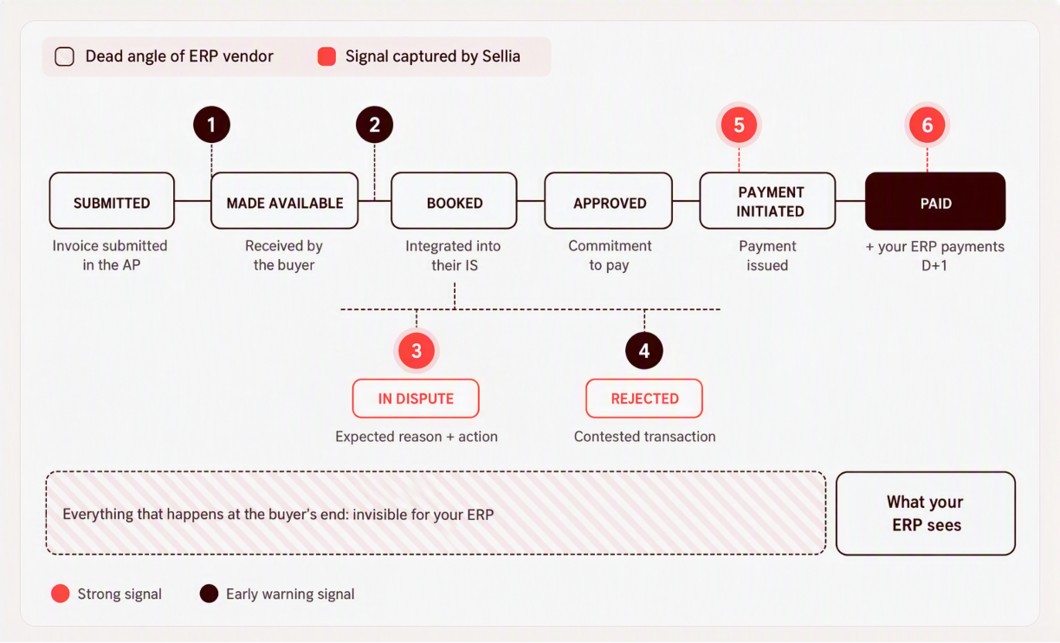
Your ERP system tracks payments. Sellia tracks the entire invoice lifecycle.
Every status change on your customer’s end is a data point. Sellia tracks the time between status changes, disputes, and rejections, and converts them into credit risk signals—well before the first late payment occurs.
-
1
Buyer's Document Processing Speed
SUBMITTED → MADE AVAILABLE
A gradual increase in processing time indicates organizational strain at your client’s company, which can be detected before any incidents occur in the ERP system.
-
2
Buyer's SI Integration Speed
PROVISION → HANDLING
A growing backlog indicates overburdened accounting teams, which is often a sign of impending difficulties.
-
3
The Dispute, Before the Delay
IN DISPUTE - STRONG SIGNAL
The most comprehensive credit signal in the reform: structured rationale and expected action. It reveals a commercial disagreement before any payment delay occurs. Frequency and reasons indicate the deterioration of the relationship.
Not visible in the vendor's ERP system -
4
Repeated refusals
DECLINED × n
Repeated rejections for the same customer (unknown transactions) may indicate a termination of the business relationship or an attempted fraud. Sellia cross-checks this information with your ERP data.
-
5
Promise vs. Actual Payment
APPROVED → PAYMENT SENT - STRONG SIGNAL
The gap between the commitment to pay and the actual payment. A gradual deterioration over 3 to 6 cycles is a predictive signal of default.
Not visible in the vendor's ERP system, which only shows the payment receipt date -
6
Reconciliation Discrepancies
CASH RECEIVED ↔ ERP D+1 - STRONG INDICATOR
Sellia already receives your payments on D+1 via your ERP. Cross-checking this with the “CASH RECEIVED” status detects reconciliation discrepancies, which indicate cash flow strain on the customer’s end.
Unique Intersection: ERP ↔ PA
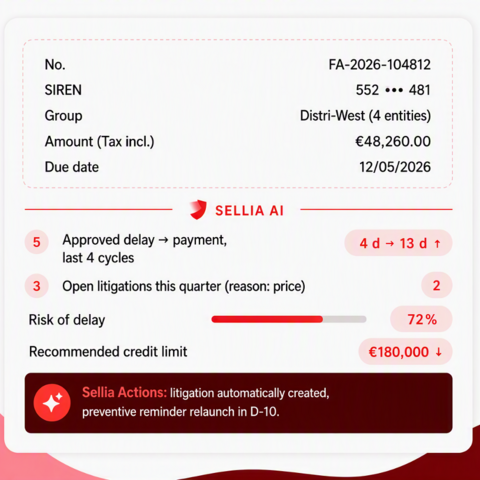
Signal ③ in action
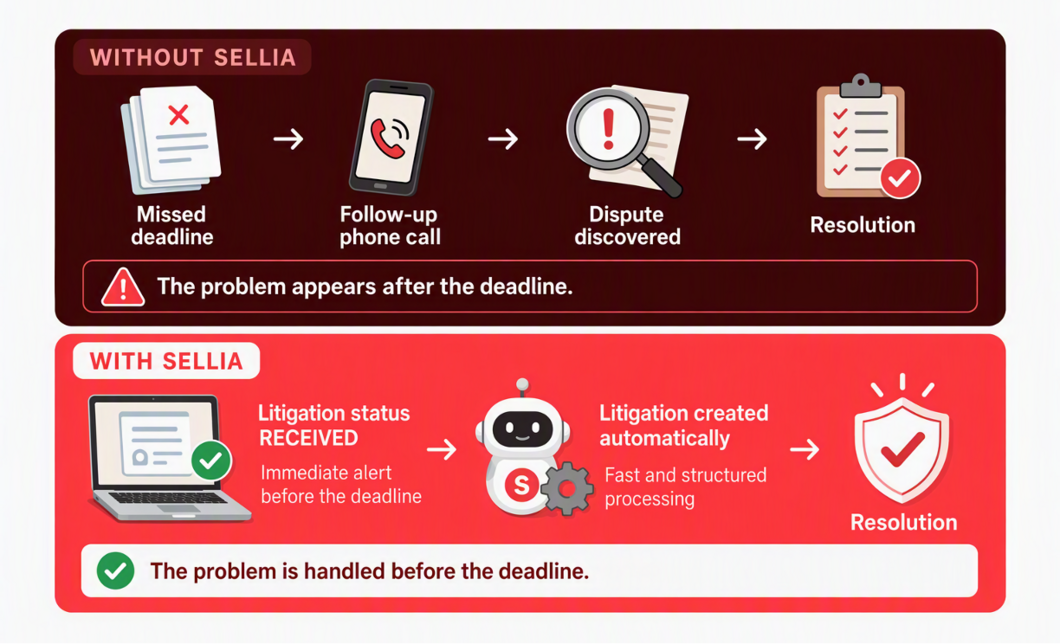
Proactive Dispute Resolution: Don’t Wait for the Customer to Call
As soon as an invoice is marked as “IN DISPUTE,” Sellia automatically creates the dispute in your collections process, along with the reason. Resolution begins sooner, and cash comes in faster.
Our Solution
From the Invoice Received to the Collection Process
Sellia enriches your e-invoicing data with your internal and external data, and then our AI models transform it into predictive insights and prioritized actions.
Connect
Electronic invoice flows from your certified platform.
- Invoices issued and received
- Life cycle statuses
1
Enrich
With your internal data and external sources.
- ERP, outstanding balances, disputes
- Legal and financial data
2
Predict
Our AI models evaluate each customer and each group.
- 6 signals derived from status updates
- Risk of Delay and Default
- Projected collectible cash
3
Take Action
Your teams focus on the right accounts.
- Recommended Credit Limits
- Prioritized follow-ups
- Automated credit decisions
4
For whom
A shared vision, from the finance department to the front lines
-
Pilots at the BFR
CFO · Finance Transformation
Turn a compliance project into a driver of financial performance.
More Reliable Cash Flow Forecasts -
Making Fairer Decisions
Credit Management
Recommended credit limits adjusted based on actual payment patterns.
Risk Detected Earlier -
Streamline the cycle
Order-to-Cash
A consolidated view by customer group, across all entities and ERP systems.
A Single View of the Portfolio -
Follow up at the right time
Collections
Disputes are automatically created once the status changes to "IN DISPUTE," and each morning, the accounts to be processed as a priority are identified.
Disputes Resolved Before the Due Date
Designed for trading
Designed for large B2B portfolios
Wholesalers and distributors manage thousands of customers and significant inventory. That's where Sellia creates the most value.
- Active B2B clients in your portfolio > 5000
- Revenue, with significant accounts receivable > 300
Talk to our expert

Contact - Name:
Germain Garnier
Senior Product Manager